



























Somewhere in a park near you, a young person is sitting alone, staring at a fixed point in the distance. No phone. No earbuds. No agenda. They’re not bored. They’re doing it on purpose.
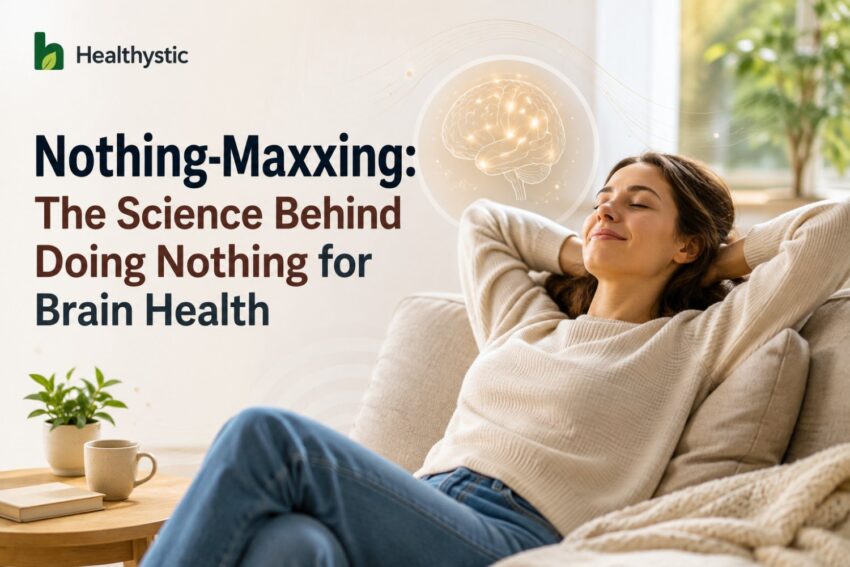
This is nothing-maxxing, a counter-cultural wellness trend that has spread across TikTok and YouTube, where users share videos of themselves doing absolutely nothing for stretches of an hour or more. In plain terms, nothing-maxxing is the practice of setting aside dedicated time, typically one hour or more, free from phones, music, and media, to allow the brain to rest and activate its default mode network, the system responsible for memory, creativity, and emotional processing.
The concept sounds deceptively simple, but the impulse behind it reflects something more serious: a generation grappling with what relentless digital stimulation is doing to their brains.
The Problem That Created the Trend
To understand nothing-maxxing, you have to start with the numbers. According to a 2025 survey by Harmony Healthcare IT, Gen Z averages more than six hours of daily phone use alone, nearly three times what health experts recommend for recreational screen time. Globally, people now spend close to six hours and 38 minutes looking at screens each day, while the average human attention span has dropped to under a minute, according to 2025 data compiled by Backlinko.
The mental health toll is hard to ignore. A 2026 survey by the North American Community Hub found that 40 percent of Gen Z report feeling stressed or anxious most or all of the time. Nearly half have already received a formal mental health diagnosis, most commonly anxiety, depression, or ADHD. Researchers at Grow Therapy note that excessive passive scrolling and social comparison on platforms like TikTok and Instagram tend to produce measurably worse outcomes than active or community-oriented use.
Many young people describe the same symptom in their own words: they can no longer finish a news article, sit through a full song, or stay present through a movie. The attention economy, designed to reward engagement above everything else, has quietly fractured their ability to focus.
Nothing-maxxing, they argue, is the antidote.
A Trend That Reinvented an Ancient Practice
The word “maxxing” originated in online communities as slang for optimizing something to its fullest extent. Looksmaxxing, gymmaxxing, and frictionmaxxing are among the other iterations that have circulated on social media, each framing a self-improvement behavior as something to be perfected and optimized. Nothing-maxxing takes the irony further: the goal is to maximize inactivity.
In practice, participants carve out at least an hour free from their phones, podcasts, music, and social interaction. They sit. They stare. They let the mind go where it goes. As The Spectator Australia noted in March 2026, the behavior essentially mirrors what humans have called meditation for thousands of years, just packaged in the language of a generation that grew up on optimization content. Content creators have turned it into a genre of its own, posting videos of themselves doing nothing, and in some cases competing over how long they can maintain the state.
The framing may be new, but the underlying practice is not. Meditation and periods of deliberate mental stillness appear across almost every major cultural tradition recorded in human history. Gen Z has not invented the concept. They’ve rediscovered it, out of necessity.
What Happens in the Brain During “Nothing”
From a neuroscience perspective, doing nothing is far from passive. When external demands are removed and attention turns inward, a specific set of brain regions activates in concert. Researchers call this the default mode network (DMN), and its activity during rest is now understood to be critical for memory, creativity, self-awareness, and emotional processing.
The DMN was first identified as an unexpected finding in brain-imaging studies. Scientists noticed that certain regions, particularly in the medial prefrontal cortex and posterior cingulate cortex, became consistently active during quiet rest and appeared to quiet down when the brain engaged with external tasks. For years this pattern was dismissed as background noise. More recent research has established that it is anything but.
A 2023 review published in the journal Neuron synthesized two decades of research on the DMN and confirmed its central role in self-referential thinking, memory consolidation, and the integration of past experiences into a coherent sense of self. A separate 2022 study in Molecular Psychiatry found that direct stimulation of the DMN during a creative task enhanced both the fluency and originality of participants’ ideas, supporting the idea that mental downtime fuels rather than impedes creativity.
There is evidence pointing in a different direction too. Research published in Frontiers in Public Health in 2025 found that nurses experiencing occupational burnout showed significantly reduced functional connectivity within the DMN compared to healthy controls, suggesting that chronic overwork doesn’t just tire people out, it may structurally impair the brain’s resting circuitry. A 2024 study in the journal Pain added another layer, finding that higher DMN activity during rest was associated with greater empathy, including an increased capacity to respond with compassion to others in distress.
The BC Brain Wellness Program at UBC summarizes the picture plainly: resting is when the mind goes to make meaning. The DMN is active during daydreaming, self-reflection, memory retrieval, and future planning. Filling every spare moment with external stimulation prevents that process from happening.
Why Scrolling Is Not the Same as Rest
This distinction is worth dwelling on, because many people assume that watching videos or browsing social media counts as downtime. Neuroscience suggests otherwise.
Passive scrolling keeps the brain’s external attention systems engaged without providing the deeper inward shift that activates the DMN. It is stimulation without restoration, input without processing. The Diggit Magazine’s analysis of screen time research puts it directly: excessive screen users experience worse sleep, lower physical activity, and higher rates of anxiety and depression, and the consumption of short-form video has measurably shortened attention spans.
The attention economy operates on precisely this mechanism. Platforms maximize the time users spend engaged, which means they are most effective when users stay in a state of reactive attention rather than quiet reflection. Nothing-maxxing, at its core, is a rejection of that arrangement.
How to Practice It (and What the Research Suggests Works)
Nothing-maxxing is unstructured by design, but the neuroscience of DMN activation points toward a few conditions that make mental rest more likely to take hold.
Removing digital devices is the most consistent recommendation across the research. Constant screen access and notification alerts keep the brain in a state of readied attention that prevents the inward shift associated with DMN activity. Even a brief phone-free period, say 20 to 30 minutes, can allow the network to engage.
Light movement in natural environments also appears to support DMN function. Taking a slow walk without a destination or any media input lets the mind follow its own thread. Research has consistently linked time in nature with reduced cortisol levels and improved mood.
Journaling after a period of quiet can deepen the effects. Writing down thoughts and feelings that emerge during downtime helps anchor the self-reflection the DMN generates, supporting memory consolidation and self-awareness over time.
Structured meditation, the older cousin of nothing-maxxing, remains one of the most well-studied approaches. Even brief daily mindfulness practice has shown measurable effects on stress, attention, and emotional regulation in peer-reviewed trials. Nothing-maxxing skips the formal method, but the underlying mechanism appears similar.
People considering any of these approaches as part of a broader mental health plan should speak with a qualified clinician, particularly if they are experiencing significant anxiety, burnout, or attention difficulties, since these can benefit from professional support alongside lifestyle changes.
A Counter-Trend With a Longer History
Nothing-maxxing exists alongside other related shifts. Hobby-maxxing, which involves deliberately filling time with hands-on activities like pottery, gardening, or cooking, has also grown among the same demographic. Both trends share a common thread: deliberate resistance to passive screen consumption, and a search for experiences that feel more tangible and restorative.
The language is new. The packaging is very online. But the behavior itself, sitting quietly with one’s own thoughts, is older than most of the world’s religions. That young people are rediscovering it without being told to, in the same apps that created the problem they are trying to solve, says something worth paying attention to.
The brain, it turns out, was not built for nonstop output. It needs the pauses. And if calling those pauses “nothing-maxxing” is what makes the practice stick, the neuroscience doesn’t have any complaints.
Sources used:
- Harmony Healthcare IT and Backlinko for screen time and Gen Z mental health data
- Spectator Australia (March 2026) for the origin and cultural context of the nothing-maxxing trend itself
- Peer-reviewed research: Neuron (2023 DMN review), Molecular Psychiatry (2022 DMN + creativity), Frontiers in Public Health (2025 burnout + DMN), and Pain (2024 DMN + empathy)
- BC Brain Wellness Program at UBC for accessible DMN synthesis

Hello reader, I’m Abhishek Kumar Shankhwar, a mental health and wellness enthusiast and a digital marketer by profession. I’m driven by a purpose to inform, inspire, and positively impact lives through meaningful content. You’ll likely find me exploring human psychology, spirituality, experimenting in the kitchen, or reflecting on life’s deeper questions. I’m also VP of Digital Marketing at Dignitas Digital, an award-winning digital agency in Philadelphia, where we drive client success through AI-powered, ROI-driven marketing strategies and tech-forward solutions. Connect with me on LinkedIn to explore potential synergies.
Disclaimer: This article is for general informational and educational purposes only and is not a substitute for professional medical advice, diagnosis, or treatment. Always consult a qualified healthcare professional before making decisions about your health, including changes to your diet, exercise, supplements, or medications.