


























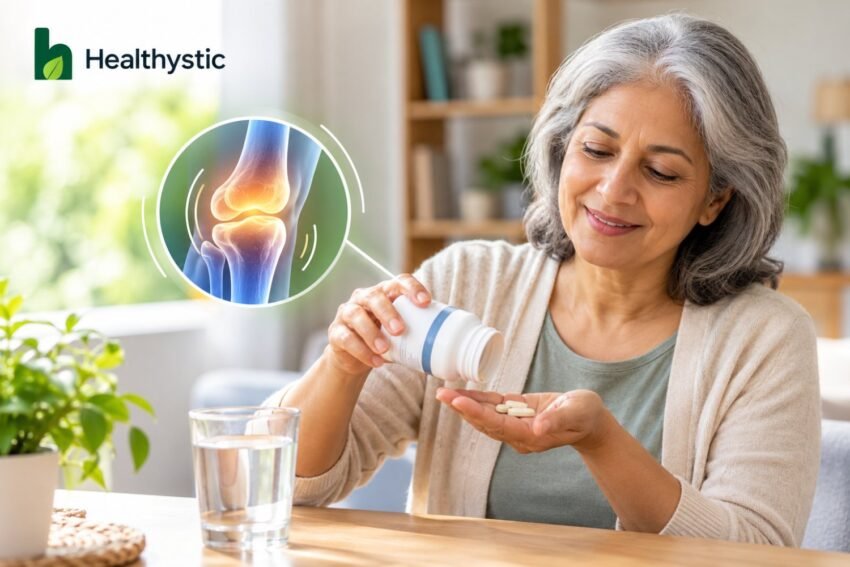

Millions of older adults take glucosamine to ease stiff, aching joints. A University of Florida team now reports that, among people with early memory problems, those who used the supplement were more likely to go on to develop dementia.
The finding comes with a large asterisk. It is an association drawn from patient records, not proof that glucosamine harms the brain. But the researchers back it with experiments in mice and human brain tissue that point to a possible biological explanation, and they say the question deserves a proper clinical trial.
The work was published in Nature Metabolism and summarized in a UF Health release carried by ScienceDaily.
Tens of thousands of patient records, and one 25% figure
The team, led by senior author Ramon Sun, analyzed deidentified UF Health records from 2012 to 2024. Software scanned clinical notes for mentions of glucosamine, which let the researchers sort patients into users and non-users. About 8% of patients in the diagnostic groups were classed as users, according to the study. That included 1,896 people with Alzheimer’s disease or a related dementia and 2,750 people with mild cognitive impairment, or MCI.
MCI describes memory or thinking problems that go beyond what is expected with normal aging but do not necessarily get in the way of daily life. It is often a stepping stone toward dementia, though not everyone with MCI progresses.
After adjusting for age, sex and demographics, glucosamine use was associated with a 25% higher likelihood that MCI would progress to dementia. Among people who already had dementia, use was tied to a 25% higher risk of death during follow-up. That mortality link did not appear in the MCI group, which the researchers read as a hint that any harm may matter more once dementia is established.
Why the records cannot settle the question
Co-author Matt Gentry, who chairs UF’s Department of Biochemistry and Molecular Biology, called the health-record data “very provocative.” He was quick to add that an association is not proof of cause, and that the results raise a clinical question rather than answer one.
The design explains the caution. Nobody in this analysis was assigned glucosamine or a placebo. People who take a supplement can differ from those who do not in ways that records fail to capture, and any of those differences could account for part of the gap.
A relative figure also hides the scale. Saying one group’s risk is 25% higher describes how the two groups compare, not how many people that adds up to.
A sugar-tagging system that runs too hot
To look for a mechanism, the team turned to the brain itself. Cells routinely attach chains of sugars to proteins, a process called glycosylation. The tags help proteins fold correctly, reach the right place and do their jobs. Gentry compared proteins to molecular machines that need those tags added just right.
In Alzheimer’s, the researchers say, the system appears overactive. Human frontal cortex samples from people with the disease carried more of these sugar chains than samples from controls. That first comparison used three samples per group. A second set, sorted by disease stage, showed the increase in grey matter growing as the disease advanced.
Two different mouse models of Alzheimer’s, one driven by amyloid and one by the protein tau, showed the same rise. Experiments with labeled glucose indicated that cells were making more sugar chains, rather than clearing them more slowly.
Glucosamine enters the picture because it is a sugar-related molecule that can cross the blood-brain barrier, the tightly controlled boundary between the bloodstream and brain tissue. Once inside, it can feed the same pathway. Commercial supplements can be made from shellfish shells or corn.
What happened when mice got glucosamine
The researchers gave Alzheimer’s model mice glucosamine by mouth for two weeks, at a dose scaled from a human amount of about 2,500 milligrams a day. Brain sugar chains rose, and the mice did worse on a social memory test that checks whether an animal recognizes a mouse it has met before.
Going the other way helped. Two separate methods of dialing down the pathway, one genetic and one a chemical inhibitor, improved memory performance in the model mice. Sun said that correcting the metabolic defect could complement treatments aimed at the plaques and tangles that dominate Alzheimer’s research.
Plaques are clumps of amyloid beta between brain cells. Tangles are twisted tau protein inside neurons. In these experiments, neither glucosamine nor the pathway blockers changed plaque levels or the number of reactive astrocytes, a marker of brain inflammation. The memory effects showed up anyway.
Healthy mice told a different story. The same glucosamine regimen did not raise sugar chains in their brains or impair their social memory. The authors say that fits the records, where glucosamine users with MCI showed no mortality difference, and suggest the harm may depend on an already disrupted brain metabolism.
The mouse work has limits of its own:
- The treatment lasted only two weeks.
- Groups were small, with six glucosamine-treated mice and seven controls in the memory test.
- The mice were female and about eight to nine months old.
- Mouse models mimic parts of Alzheimer’s, not the whole human disease.
Where the joint evidence stands, and what comes next
Glucosamine is sold in the United States as a dietary supplement. The National Center for Complementary and Integrative Health (NCCIH) says large osteoarthritis studies have found no major safety problems. It adds that glucosamine may raise blood sugar in some people and has been linked to a higher bleeding risk in people taking the blood thinner warfarin.
Whether it eases joint pain is less settled. One review of trials in knee and hip osteoarthritis found effect sizes that were generally small and probably not clinically relevant, and it noted a high risk of bias in many studies. NCCIH also notes that a 2019 European society statement recommends prescription crystalline glucosamine sulfate for knee osteoarthritis while discouraging other formulations. The Nature Metabolism authors point out that supplements are regulated less strictly than prescription drugs and can vary in quality and purity.
The UF team does not claim its results tell anyone to stop taking glucosamine. Instead, the researchers call for a controlled, double-blind human trial to test whether the supplement speeds Alzheimer’s progression and which patients might be most vulnerable. They also point to the scale of the question. Because roughly 8% of the patients in their records used glucosamine, they estimate that more than a million people with Alzheimer’s or related dementias in the United States could be taking it. That figure is the authors’ extrapolation from one health system.
Until such a trial exists, the answer stays open. People with MCI or dementia, and the relatives who help manage their medications, can bring up supplement use with a clinician who knows their full picture.

Hello reader, I’m Abhishek Kumar Shankhwar, a mental health and wellness enthusiast and a digital marketer by profession. I’m driven by a purpose to inform, inspire, and positively impact lives through meaningful content. You’ll likely find me exploring human psychology, spirituality, experimenting in the kitchen, or reflecting on life’s deeper questions. I’m also VP of Digital Marketing at Dignitas Digital, an award-winning digital agency in Philadelphia, where we drive client success through AI-powered, ROI-driven marketing strategies and tech-forward solutions. Connect with me on LinkedIn to explore potential synergies.
Disclaimer: This article is for general informational and educational purposes only and is not a substitute for professional medical advice, diagnosis, or treatment. Always consult a qualified healthcare professional before making decisions about your health, including changes to your diet, exercise, supplements, or medications.